
The Hidden Role of Your Feet in Balance and Pain
Do you walk or run as much as you would like? If not, what stops you?
Some of us have difficult schedules or less than ideal options for outdoor activities; however, a commonly stated reason for reduced walking and running is pain. Pain in the knees, hips, and feet are frequently cited as the reason for decreased physical activity. This problem tends to increase with age, although that depends on the origin and management of our pain.
Where do these mystery pains come from anyways? Genetic factors can certainly affect your likelihood of developing arthritis or other conditions that lead to joint pain, but we have little control over those factors. Instead, let's focus on lifestyle factors where we have more agency in outcomes.
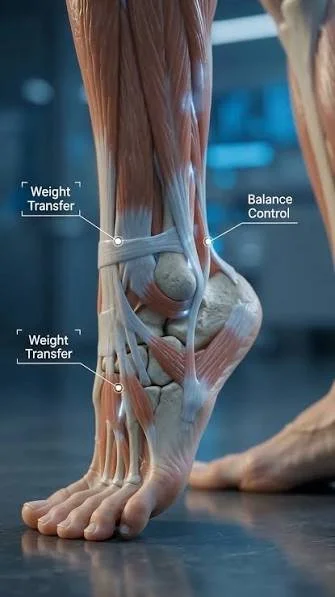
Human locomotion, both walking and running, starts with the feet. Your feet are doing a lot more than simply keeping your shoes off the ground, they are the foundation of your mechanics.
Every time your foot hits the ground, it has to deal with forces that can be several times your body weight. It has to adapt to the surface, control your body, absorb force, and then help produce the next step. How well can your feet tolerate that stress and responsibility?
The gait cycle of foot strike and lift-off occurs as quickly as a fraction of a second and repeats for the duration of your activity. When the feet support and move well, they help the rest of the body move efficiently. When they don't, the body has to find another way to complete the movement. And that's where things can get interesting.
Most of us rely on our body without doing much maintenance or preparation. If you are not regularly supporting your feet or training them to keep up with your desired activities, don’t miss this article!
Your Feet Are Designed to support, but also to move
None of us were given a manual explaining the do’s and don’ts of using our feet. We learn to walk and run in ways that are energy efficient or mirror someone else. Typically we don’t feel pain during this learning process, but rather over years of misuse creating wear and tear.
Our movement strategies, therefore, can be misinformed. One common misconception, for example, is that the foot should be rigid all the time to keep us balanced and supported.
Surprise! It shouldn't.
Rather we need the foot to fulfill two seemingly opposite things: Mobility of the foot, during the landing phase, absorbs ground reaction forces; Stability, in contrast, enables us to make the foot rigid enough to transfer force as we push-off into our next step.
Think of your foot like a suspension system that can change its characteristics depending on where you are in the running cycle.
Too much movement can create problems as can too little movement.
Train the foot to walk and run well by working both range of movement and strength in each position. Sounds easy, but first we need to know our options for foot movements!
What movements do we need from our feet?
Your foot undergoes two primary movements: Pronation and Supination. Neither are good or bad, only positions we move to and from.
When your foot contacts the ground, your arch flattens and spreads out to absorb force. This pronation requires that your foot can turn and tilt outward as well as lifting the foot and toes. Conversely, pushing off into your next step pushes the foot and toes downward as you tilt the foot inward to lift your arch. Considering these requirements, we can examine ways to challenge the foot in ways that overlap with how we use it in locomotion.
Your body doesn't experience joint motion or transfer of force independently.
Look upwards from the foot to the knee, hip, pelvis, and spine. Our body must manage forces and movement up the chain. The foot is the entry point for ground forces in running and walking, so it can be our most powerful method of supporting the body in motion. One small movement at the bottom of the chain can have consequences much farther up.
Movement at one joint changes the position, forces, and movement requirements of the joints above and below it. Examine the mechanics and you can find many tools for training the feet and by extension all other joints in the chain.
How Feet move the Knees
Knees are the most often irritated joints. Yet by their structure and more ideal use, we wouldn’t expect this to be the case. These joints are heavily influenced by the positioning of the hips and feet. Use this as an example:
Stand up and point your knees together and apart. What motions happen at your feet? Did they twist in place? Did the arches lift and lower? Or were they perfectly stiff?
Feet lacking mobility will tend to stay rigid while feet lacking stability will move without any control.
When we walk and allow the foot to move with no support, the knee is pulled in the same direction. This creates different stresses along the sides of your knee and can accumulate a lot of damage with repeated steps in these positions.
This doesn't mean that the mobility of the foot is bad. Rather, the foot leads the knee to a more stressful position, and our response should be training stability of the foot and ankle to enhance our knee support.
A runner may develop what looks like a "knee problem" when the knee is simply responding to movement occurring somewhere below it.
This is why treating the painful area without understanding the movement contributing to it can sometimes feel like playing whack-a-mole.
This interconnected system continues upwards with the hips.
Chain of motion from Feet to Hips
Changes in foot mechanics can affect how the lower leg rotates, which can influence the position and movement of the hip. The hip then has to control the movement of the entire leg while also stabilizing the pelvis.
This is particularly important during running because you're spending much of the gait cycle on one leg. If the foot isn't providing a stable and predictable base, the muscles around the hip may have to work harder to control the movement above it.
Training these aspects together can build familiarity with the connection between each link.
Again, the foot’s ability to support these positions is equally important to its ability to move through its full range of motion.
Consider the entire movement system rather than assuming that one joint is responsible for everything.
The Foot and Spine connection
This one might sound like a stretch. How could one possibly affect the other?
Remember the chain. Foot position influences lower-leg movement. Lower-leg movement influences the knee. The knee influences the position and movement of the hip. The hip influences the pelvis.
The pelvis is the foundation of the spine. Changes in pelvic position can influence how the spine moves and how muscles around the trunk have to work to maintain balance.
Difficulty with maintaining balance in the spine should include a check-in with foot strength and movement. Are the feet holding position enough? Are they tight and not absorbing enough stress?
Look at some examples of organizing the body in motion.
None of this means that a particular foot position automatically causes back pain. Human movement is far too complicated for that simple of a solution.
Rather, we must remember not to ignore the structure that hits the ground hundreds or thousands of times during a run when the painful spot is high up in the spine.
Common areas for improvement
There isn't one "bad" foot. Feet come in different shapes, sizes, and structures. Some people naturally have high arches. Others have flatter feet. Some have highly mobile feet, while others have relatively rigid feet.
Variation is normal.
The bigger concern is whether your foot can meet the requirements of locomotion.
Excessive Pronation/Supination (Low vs. High arches)
Resting arch position tends to be unfairly accused for many people. Pronation, a low or flat arch, is a normal position of the foot that helps absorb the ground forces. Supination, or high arch, is also normal movement of the foot assisting in the force transfer into the ground as we push-off to our next step.
Problems can arise with excessive or poorly controlled motions relative to their individual strength, mobility, and running demands. If the foot is not regulating its position, other joints will be pulled along with it.
Similarly, restricted mobility will reduce the absorption of ground forces and lead to restricted mobility of joints up the chain.
Again, resting arch position isn't the enemy. Instead, focus attention on the real culprits, unsupported or immobile joints.
Weak Foot Muscles
Your feet contain dozens of small muscles.
These muscles help control the shape and position of the foot while providing sensory information about your interaction with the ground.
Weakness or poor coordination in these muscles may reduce your ability to control foot movement.
Fortunately, these muscles all work together, so we can emphasize doing a small list of exercises frequently to train up and movements that are losing support.
Give your feet alternative opportunities to actively work from your usual routine.
Poor Foot Awareness
Your feet house hundreds of thousands of sensory receptors.
Your brain receives constant information from receptors in your feet about pressure, contact, position, and movement. This information helps your nervous system determine where your body is in relation to the ground.
If you've spent your entire day wearing shoes and then immediately expect your feet to provide highly detailed sensory information during a run, you're asking them to do a lot without much practice.
Find opportunities to move your feet outside of your shoes. Feel the floor and where your foot rests on it when standing or walking. Where does it go, or not go? How difficult is it to feel these positions?
More information for the foot encourages activity of the supporting muscles.
Checking the physical status of your feet
Your feet do much more than carry you through your run. They help determine how you interact with the ground, absorb forces, maintain balance, and transfer energy into your next step. They provide mechanical support. They provide sensory information. And they influence movement throughout the rest of your body.
This is no small list of tasks, so consider how much training you might need.
Our goal is to have feet that are strong enough, mobile enough, and coordinated enough to handle the demands you place on them. If you're a runner, those demands are very significant. If you want to maintain upright mobility through your old age, the demands become even more significant.
You don't have to wait until your feet, knees, hips, or back start hurting to pay attention to your movement.
Join us for Foot & Balance Screening Day and get a closer look at how your feet are contributing to your balance and movement.
A screening can help identify differences in foot strength, mobility, balance, and control that may be influencing how you move.
Your feet are the foundation of every step.
Written by Aaron Westbrook. Edited by Michelle Amore
Find out how well yours are supporting you. Schedule a Foot & Balance Screening.
Articles:
Menz, H. B. (2016). Chronic foot pain in older people. Maturitas, 91, 110-114.
Sullivan, Justin, Joshua Burns, Roger Adams, Evangelos Pappas, and Jack Crosbie. "Plantar heel pain and foot loading during normal walking." Gait & posture 41, no. 2 (2015): 688-693.
Benvenuti, F., Ferrucci, L., Guralnik, J. M., Gangemi, S., & Baroni, A. (1995). Foot pain and disability in older persons: an epidemiologic survey. Journal of the American Geriatrics Society, 43(5), 479-484.